Hydraulic Bed Loading
The operator lowers the bed into a ramp, aligns it with the tires, and uses a weight-rated winch cable to pull the vehicle aboard at a controlled speed.
At Tucson Towing Co., flatbed towing means loading the entire vehicle onto a hydraulic platform so all four wheels remain off the road. This approach gives the operator controlled loading for disabled vehicles, accident recovery, motorcycles, and long-distance transport while avoiding added tire and drivetrain wear. This guide explains what happens from positioning and winching through securement and unloading.
The operator lowers the bed into a ramp, aligns it with the tires, and uses a weight-rated winch cable to pull the vehicle aboard at a controlled speed.
Axle straps, wheel baskets, or chains are selected for the vehicle, attached at four load-rated points, and checked again after the bed returns to travel position.
Once the platform is level, the vehicle rides entirely on the truck, preventing its tires, suspension, and drivetrain from turning or carrying road load during the haul.
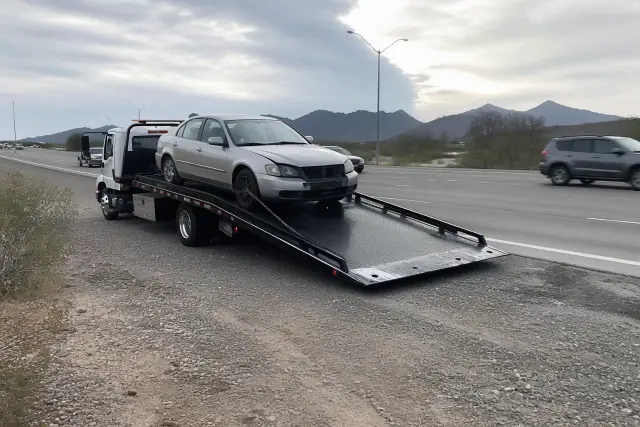
The tilted bed forming a low ramp directly in line with the vehicle's tires. Correct alignment protects clearance and keeps the winch pull straight.
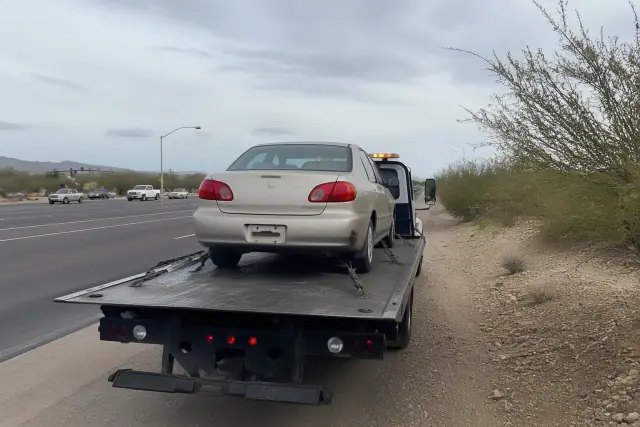
The vehicle centered on the platform with a securement point at each corner. This image helps make strap routing and balanced weight distribution easy to inspect.
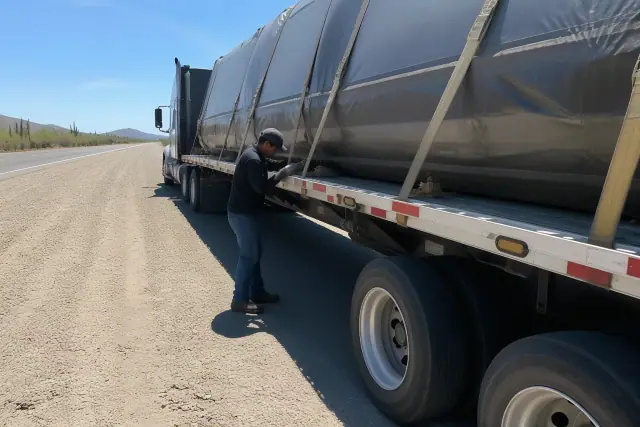
The bed level in travel position while the operator checks each strap or chain. This last inspection confirms the vehicle is stable before the truck enters traffic.
Roughly 10-15 minutes for a standard sedan in normal conditions; locked wheels or collision damage can extend the process.
Hydraulic tilt beds and winches are typically rated from 8,000-25,000 lbs, depending on the truck class.
Federal Motor Carrier Safety Administration cargo-securement rules require a minimum of four rated tie-down points. Ratchet straps or chains are rated to at least a 5,400 lbs working load limit.
Area rates typically run $150-$200 for the base hookup plus $2.50-$7 per mile, with vehicle class and distance affecting the total.
| Factor | Flatbed Towing | Wheel-Lift Towing |
|---|---|---|
| Road contact | All wheels stay on the bed. | Two wheels roll on the road. |
| Best fit | All-wheel drive, four-wheel drive, disabled, collision-damaged, motorcycle, low-clearance, and long-distance moves. | Straightforward local tows for compatible, drivable vehicles. |
| Loading method | A tilted hydraulic bed and winch raise and center the vehicle. | A yoke lifts one axle while the other remains down. |
| Transport effect | No added tire, drivetrain, or odometer miles. | Compatibility matters because one axle remains in motion. |
After checking the vehicle's condition, drive type, ground clearance, and gross weight, the operator positions the truck. Two hydraulic cylinders tilt the bed roughly 10-15 degrees, while a separate motor drives the weight-rated winch cable that pulls the vehicle up at a controlled speed. The operator guides the wheels, centers the vehicle's mass, returns the bed to horizontal, and performs a final tie-down check before transport. Unloading reverses the sequence, with the winch controlling descent after brake and steering condition are checked.
Flatbeds are suited to all-wheel drive and four-wheel drive vehicles, damaged transmissions, locked brakes, broken axles, collision damage, motorcycles, and low-clearance or classic cars. Light-, medium-, and heavy-duty jobs require a bed, winch, and securement gear matched to the vehicle's weight class; motorcycles use wheel chocks and soft-tie straps, while heavier equipment may require chains. Common mistakes include choosing under-rated straps, ignoring uneven weight distribution, or skipping the brake and final strap checks. For roadside work around Interstate 10 and Speedway Boulevard, Arizona Department of Transportation requirements include reflective safety triangles and amber warning lights.
Does flatbed towing add mileage? No-the wheels never turn on the road, so the odometer does not gain miles from the tow. What is the 80% rule? It generally refers to keeping a towed load within 80% of the tow vehicle's rated capacity to retain a braking and handling margin. Can a loaded setup back up? Reversing even a few feet can bind tow bars or rigging, so the safer approach is to unload and reposition. Insurance roadside-assistance riders commonly cover $75-$150 per incident, subject to the policy's mileage or dollar cap. Arizona Revised Statutes Title 28 governs towing statewide, while Tucson non-consent private-property tows require Tucson Police Department notification within one hour and photo documentation.
Share the vehicle's drive type, condition, ground clearance, pickup point, and destination so the local team can match the truck class and loading method to the job. Flatbed help is available around the clock across Tucson, including downtown, the Catalina Foothills, Marana, and Vail, with long-distance transport through the Sun Corridor toward Phoenix and beyond.