Proudly serving Tucson, Oro Valley, Marana, Sahuarita, Green Valley, Vail & surrounding areasCall or Text 24/7: +1 (520) 567-5263

Flatbed Towing in Tucson, AZ for Specialty Loads & Damage-Free Vehicle Transport

Tucson Towing Co. provides flatbed towing throughout Tucson for disabled passenger vehicles, commercial fleets, motorcycles, and specialty loads. Our services include emergency towing, roadside assistance, accident recovery, light-, medium-, and heavy-duty towing, long-distance transport, and car lockout and jump-start help. Hydraulic rollback flatbeds keep all four wheels off the road, while synthetic winch straps and axle-rated tie-downs protect rims, drivetrains, and undercarriages. Dispatch matches each call with an appropriately sized truck based on vehicle class and condition.

Extreme pavement heat can turn tire and battery trouble on I-10 or I-19 into a roadside emergency quickly. A rush-hour breakdown near Miracle Mile needs different routing from a 2 a.m. call in Catalina Foothills, so GPS dispatch sends the closest available appropriately sized truck. Operators use low-clearance loading methods for lowered vehicles and manufacturer-specific procedures for AWD and 4WD drivetrains. Arizona motor carrier registration, commercial insurance, and upfront pricing add practical protection before the vehicle moves.

Call with your location, vehicle make and model, destination, and whether the vehicle is drivable, involved in a collision, or blocking traffic. Dispatch will explain what the tow involves and quote the job before sending a truck.

Tucson Towing Co. provides flatbed towing in Tucson and nearby Marana, Oro Valley, Sahuarita, Vail, and Green Valley.

★ ★ ★ ★ ★4.9/5 Average Rating · 20+ Years of Experience · Thousands of Customers Helped · Licensed & Insured · Residential & Commercial

Flatbed Towing Options & Benefits

How Flatbed Towing Protects Your Vehicle

A flatbed carries the entire vehicle with all four wheels off the road. That prevents added drivetrain wear, avoids recording towing mileage on a transmission that may already be failing, and reduces the risk of scraping a low front bumper.

Hydraulic rollback decks create a controlled loading angle, while synthetic winch straps, soft wheel ties, and axle-rated tie-downs secure the vehicle without chains against rims or undercarriage components. The operator selects the deck, ramp, and securement method for the vehicle's weight and configuration.

This approach works for everyday sedans and SUVs as well as lowered cars, AWD and 4WD vehicles, motorcycles, commercial units, and specialty builds. Recovery equipment can first free a vehicle from wash sand or a roadside shoulder before it is loaded for transport.

Benefits of Flatbed Transport

The right flatbed setup protects the vehicle during loading, transport, and unloading while giving dispatch flexibility for different road, recovery, and vehicle conditions.

  • All four wheels remain off the road during transport.
  • AWD and 4WD drivetrains avoid wheel-on-road rotation.
  • Low-clearance loading helps protect bumpers and trim.
  • Soft ties and synthetic straps reduce contact with finished surfaces.
  • Deck and axle capacity are matched to the vehicle class.
  • Wheel chocks keep motorcycles upright without compressing forks.
  • Rollback transport limits tire wear on long highway moves.
  • Upfront quotes account for distance, weight, and time of day.
Tucson Towing Services

Flatbed Towing Services

Tucson Towing Co. matches passenger vehicles, commercial loads, collision scenes, and roadside calls with the equipment each situation requires. Coverage extends from residential streets and freeway shoulders to fleet routes and construction sites across the Tucson metro.

Light-Duty Flatbed Towing

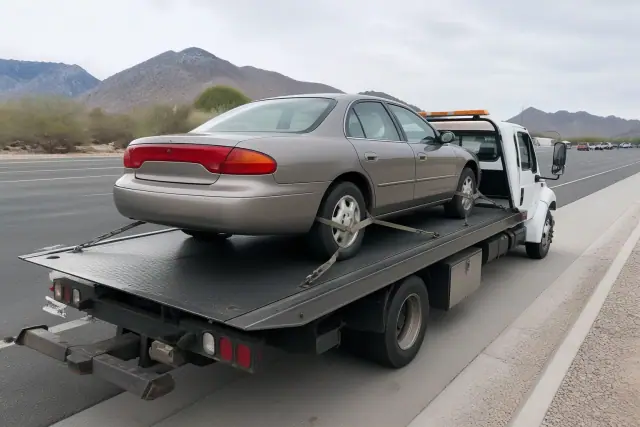
Flatbed tow truck with a secured sedan on a roadside in Tucson, AZ, with desert mountains in the background.

Smaller rollback trucks carry sedans, hatchbacks, and compact SUVs while maneuvering on tight residential streets. They are well suited to curbside loading in neighborhoods such as Sam Hughes and Barrio Viejo.

Request Estimate

Medium-Duty Flatbed Towing

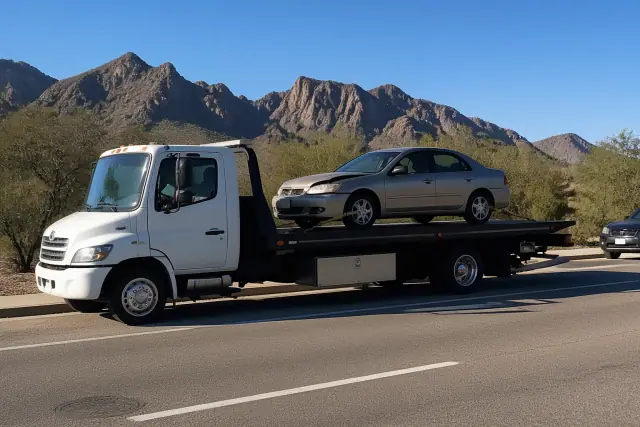
A flatbed tow truck with a secured disabled sedan parked on a multi-lane road in Tucson, AZ with desert mountains behind.

Pickups, cargo vans, and small box trucks need additional deck capacity and reinforced ramps. Medium-duty flatbeds move these vehicles without exceeding axle ratings or overloading the winch system.

Request Estimate

Heavy-Duty and Commercial Towing

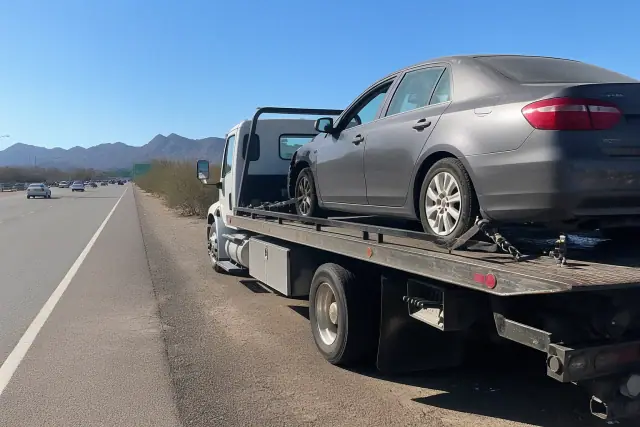
Flatbed tow truck with a disabled sedan on a highway shoulder in Tucson, AZ, with desert mountains in the background.

Higher-capacity equipment supports loads ranging through Class 6 box trucks, commercial fleet vehicles, tractor-trailers, and construction equipment. Rotator-capable heavy-duty rigs handle breakdowns and accident recovery along the I-10 freight corridor when the load or scene demands industrial towing equipment.

Request Estimate

Emergency Towing and Accident Recovery

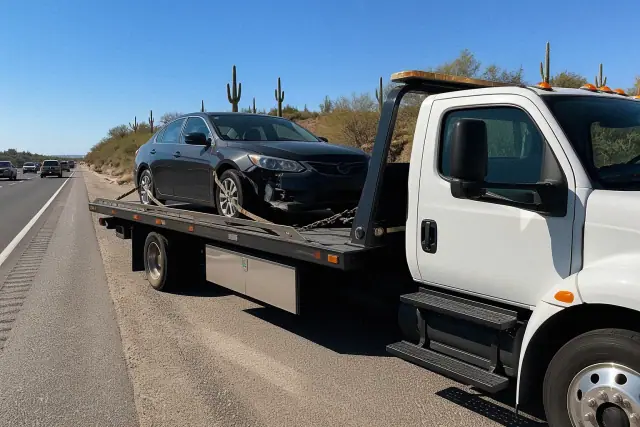
A flatbed tow truck with a disabled sedan on the highway shoulder in Tucson, AZ with desert saguaros in the background.

Crews answer towing calls 24/7, including overnight breakdowns and collision scenes. Flatbeds remove damaged vehicles while helping preserve their condition for insurance documentation, and operators can photograph damage and coordinate with responding officers or an adjuster when requested.

Request Estimate

Roadside Assistance

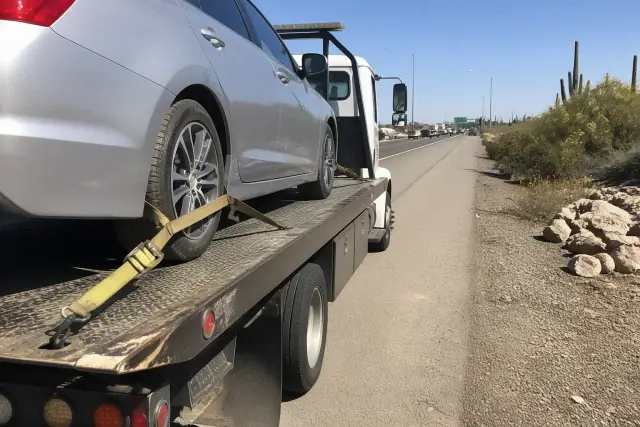
Flatbed tow truck with a disabled sedan secured on the highway shoulder in Tucson, AZ.

When a tow is not necessary, roadside service can cover a tire change, fuel delivery, a jump start, battery replacement, or help with a locked car. Dispatch confirms the location, vehicle, and problem so the right tools arrive on the first trip.

Request Estimate

Motorcycle and Specialty Towing

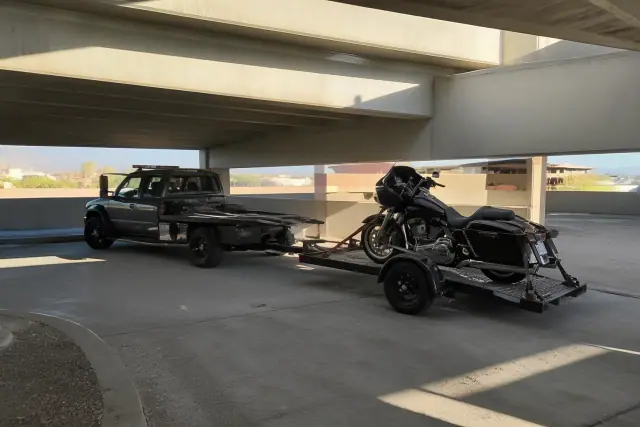
A low-clearance tow truck moving a motorcycle on a trailer in a concrete parking structure in Tucson, AZ.

Motorcycles ride upright with wheel chocks and soft-tie straps that protect forks and fairings. Heavy-duty flatbeds, axle-rated ramps, and load-rated chains are available for skid steers, small excavators, and other job-site equipment.

Request Estimate
Transport and Recovery Options

Flatbed Equipment and Loading Solutions

Vehicle weight is only one part of choosing a tow setup. Drivetrain, ground clearance, recovery conditions, distance, and load securement all affect which truck and loading method should be sent.

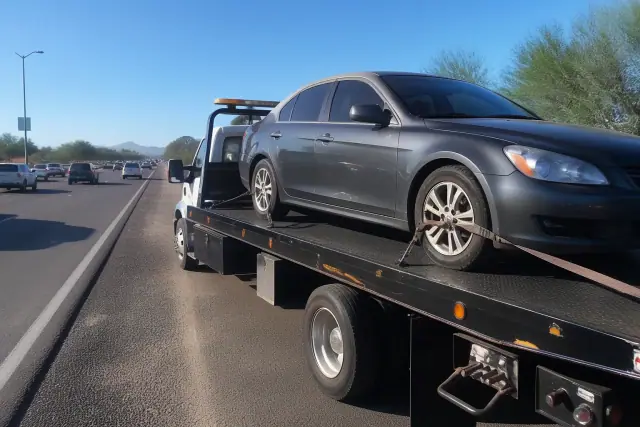
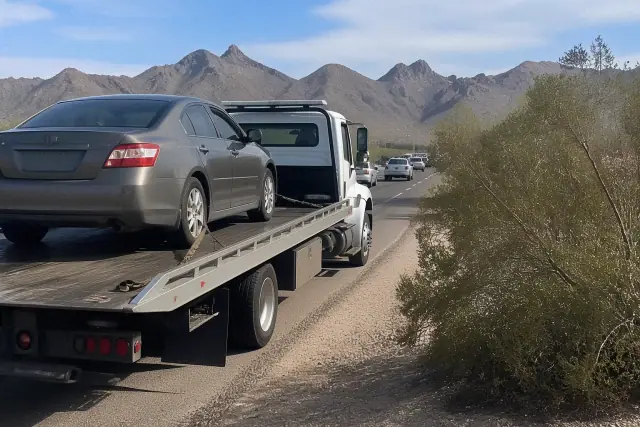
A flatbed tow truck carrying a disabled sedan on a busy road in Tucson, AZ.

Vehicle-Matched Flatbed Capacity

Dispatch uses the vehicle type and weight class to select a rollback with enough deck, axle, ramp, and winch capacity. That keeps the load within equipment ratings instead of forcing a larger vehicle onto an undersized truck.

  • Compact sedans and hatchbacks on smaller rollbacks
  • Compact SUVs with vehicle-appropriate tie-down points
  • Pickups and cargo vans on higher-capacity decks
  • Small box trucks through Class 6 where equipment ratings allow
  • Commercial vehicles and equipment on heavy-duty rigs
Request Estimate
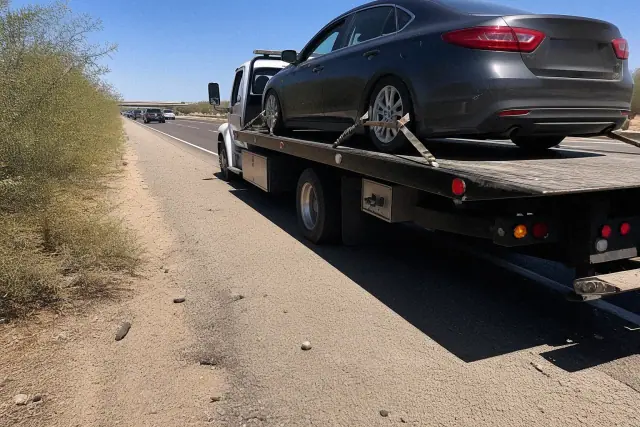
Flatbed truck securing a sedan with heavy-duty straps on a highway shoulder in Tucson, AZ.

Drivetrain and Clearance Protection

Flatbed loading can be adjusted for drivetrain layout and body clearance. The goal is a controlled pull onto the deck with securement points that do not create new mechanical or cosmetic damage.

  • All four wheels raised clear of the road
  • Manufacturer-specific procedures for AWD and 4WD vehicles
  • Low loading angles for lowered cars and low front bumpers
  • Synthetic winch straps instead of chains against finished parts
  • Soft wheel ties and axle-rated straps for secure transport
Request Estimate
Flatbed tow truck with a disabled sedan secured on the side of a road near Tucson, AZ with desert mountains behind.

Recovery and Accident Handling

A vehicle in wash sand, off a shoulder along Kolb Road, or damaged in a collision may require recovery before transport. Operators assess the surface and vehicle position before choosing the pull direction and rigging.

  • Ground-stability assessment before winching
  • Snatch blocks and rated cable for controlled recovery
  • On-scene photographs of collision damage
  • Prompt lane-clearing coordination with responding officers
  • Insurance-adjuster coordination when the customer requests it
Request Estimate
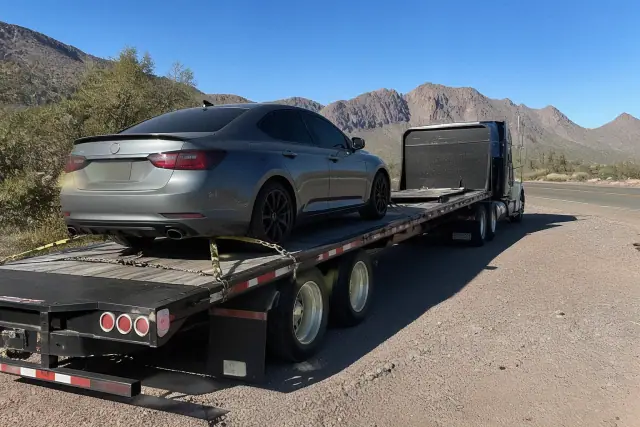
A heavy-duty truck and transport trailer parked at a desert highway pull-off in Tucson, AZ.

Long-Distance Vehicle Transport

Tucson is 108 miles southeast of Phoenix and roughly 60 miles north of the U.S.-Mexico border, so longer vehicle moves are a regular part of local towing needs. Rollback transport keeps tires and drivetrains from accumulating the wear associated with dolly towing over hundreds of highway miles.

  • Vehicle delivery to dealerships in Phoenix
  • Out-of-state transport after I-19 breakdowns
  • Open flatbeds for standard passenger vehicles
  • Enclosed transport for exotic and vintage vehicles
  • Transport options for RVs and boat trailers
Request Estimate
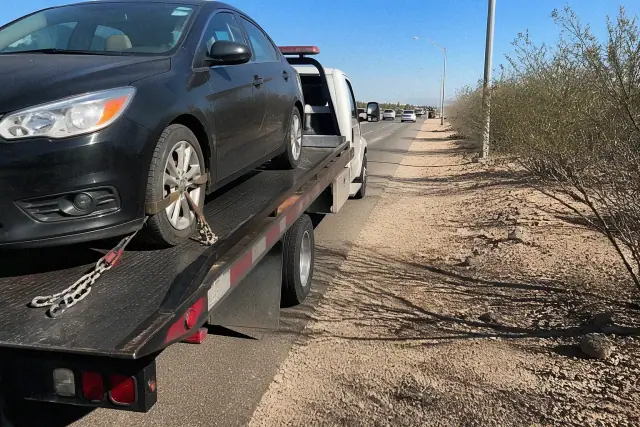
A flatbed tow truck with a secured sedan on a roadside in Tucson, AZ, with desert scenery and safety chains visible.

Roadside Support Before a Tow

Not every disabled vehicle has to leave on a flatbed. Roadside assistance can resolve common battery, tire, fuel, and access problems when the vehicle is otherwise safe to drive.

  • Jump starts for discharged batteries
  • Battery replacement when a jump will not fix a dead cell
  • Tire changes for roadside flats
  • Fuel delivery on long desert routes such as Ajo Way
  • Car lockout assistance
Request Estimate
Choosing the Right Tow

Choosing the Right Flatbed Towing Approach

The correct approach depends on vehicle class, drivetrain, ground clearance, current condition, pickup location, and destination. Dispatch also needs to know whether the vehicle is drivable, in a collision, stuck off-road, or blocking traffic so it can assign the proper truck and explain the price before the operator leaves.

GPS-Dispatched Local Operators

Real-time GPS routing helps dispatch the closest available suitable truck instead of relying on a rough guess. Local operators know monsoon-prone Rillito River wash crossings and the tight one-way streets around the University of Arizona.

Vehicle-Specific Loading Methods

Operators train on manufacturer-specific loading procedures because lowered cars, AWD crossovers, motorcycles, and commercial vehicles require different handling. Each truck is operated by a trained team member familiar with the company's loading standards.

Registered and Commercially Insured

The fleet operates under Arizona motor carrier registration requirements and carries commercial cargo insurance on each load. Customers can ask to see proof of coverage before a long-distance or specialty tow.

What Sets Us Apart

Why Tucson Drivers Choose Our Flatbeds

Tucson Towing Co. combines vehicle-matched equipment, local routing knowledge, transparent quotes, and careful securement practices. The standard is a damage-free load using the appropriate deck, winch, straps, and tie-down points for the vehicle rather than a one-method-fits-all tow.

Request a Tow Quote

Desert Heat Breakdowns

Summer pavement temperatures on stretches of I-10 and I-19 regularly exceed 150 degrees. That heat softens tire rubber and strains batteries, turning an ordinary commute into a sudden roadside call.

AWD and 4WD Drivetrain Risk

Towing an AWD or 4WD vehicle with wheels rotating on the road can create drivetrain stress when the manufacturer does not allow it. A flatbed carries the full vehicle so the transmission and driven axles remain stationary.

Low-Clearance Loading

Lowered vehicles and cars with low front bumpers can scrape during a steep approach or at roadway dips near Speedway and Broadway. Rollback deck angles and controlled winching reduce that clearance risk.

Collision Scene Removal

Damaged vehicles may need prompt removal when Arizona Department of Public Safety or Tucson Police Department officers are clearing travel lanes. Flatbed loading supports condition documentation for an insurance claim or total-loss assessment.

Monsoon Wash Recovery

Wash sand and flash-flood conditions can leave a vehicle without stable traction. Recovery starts with a ground assessment, then uses rated cable and snatch blocks to pull the vehicle into a safe loading position without adding undercarriage damage.

Improper Specialty-Load Rigging

A motorcycle, skid steer, or small excavator can shift or suffer damage when secured with passenger-car gear. Wheel chocks, soft ties, axle-rated ramps, and load-rated chains keep each specialty load supported by equipment designed for its weight and shape.

How It Works

Our Flatbed Towing Process

A clear dispatch and loading process reduces uncertainty from the first call through delivery. Each step identifies the vehicle's needs, documents its condition, and keeps the load secured until it reaches the chosen destination.

01.

Confirm the Call Details

Dispatch confirms the pickup location, vehicle make and model, destination, and whether the vehicle is drivable, involved in an accident, stuck, or blocking traffic.

02.

Quote the Tow

The quote accounts for distance, vehicle weight, time of day, and any difficult recovery or rigging conditions. You receive the price before dispatch so the invoice is not a surprise.

03.

Dispatch the Right Truck

GPS routing identifies the closest available flatbed with the deck and capacity the call requires. Dispatch provides a realistic arrival estimate based on the live route.

04.

Document Existing Condition

Before loading, the operator completes a walk-around and notes existing vehicle damage. Collision calls can include on-scene photographs for later insurance documentation.

05.

Load and Secure the Vehicle

The operator uses the loading angle and tie-down method appropriate for the vehicle class. Soft ties and rated straps secure the vehicle at four points before transport begins.

06.

Deliver and Inspect

The operator stays with the load through transport, unloading, and inspection at the selected destination. The vehicle is released after it is safely off the deck and its delivered condition is checked.

Get Towing Help

Request Your Tucson
Flatbed Towing
Quote

Tell dispatch where the vehicle is, what you are driving, its condition, and where it needs to go. Tucson Towing Co. will match the call to the appropriate truck and explain the price before dispatch.

Tucson Service Help

Flatbed Towing FAQs

These answers cover flatbed pricing, vehicle compatibility, roadside options, towing rules, and the information dispatch needs. Call if your vehicle or recovery situation requires a specific equipment recommendation.

Call Dispatch

Local flatbed tows in the Tucson area generally run $75 to $125 for hookup plus a set mileage radius, with additional miles billed beyond that base. Long-distance flatbed towing typically runs $2 to $4 per mile, while specialty or heavy-equipment towing with extra rigging can run $100 to $150 per hour. The final quote depends on vehicle type, distance, drivability, weight class, time of day, and recovery conditions. Tucson Towing Co. accepts credit cards and works with most insurance providers for accident-related tows.

Compare the complete price, not just a low hookup figure, because mileage and after-hours charges can change the total. Ask whether the truck is properly sized, the operator uses rated securement equipment, and the company will show current registration and insurance. Tucson Towing Co. quotes the job before dispatch and keeps pricing competitive through efficient routing.

AAA can dispatch flatbed trucks through contracted local towing providers. Tucson Towing Co. honors AAA member discounts on qualifying jobs when customers call directly, but mileage limits, coverage, and wait times vary by membership tier. Check your plan's limits before choosing how to arrange the tow.

Flat towing with all four wheels on the ground depends on the model year, transmission, and drivetrain, and most Hyundai Tucson models are not factory-rated for it without added equipment. Some manual-transmission versions may allow it under the owner's manual procedure, while automatic models generally require flatbed transport to avoid transmission damage. Check the specific owner's manual or towing guide before attempting a flat tow.

A typical flat-tow setup needs a frame-mounted baseplate, tow bar, safety cables, working tow lights, and, in most states, a supplemental braking system. The transmission must be rated for flat towing, and the steering must be set up to track correctly. Flatbed transport avoids those drivetrain and hitch-system requirements because the vehicle rides on the truck.

Securing the steering wheel is a standard part of a flat-tow setup because the front wheels remain on the road and need to track behind the towing vehicle. A steering-wheel lock holds the wheel centered against vibration and crosswinds. Flatbed transport removes this issue by carrying all four wheels off the road.

Arizona Revised Statutes Title 28 covers motor-carrier registration, vehicle weight limits, and towing-equipment standards, while Tucson City Code addresses private-property and abandoned-vehicle towing. Non-consensual private-property tows must follow applicable notice and signage requirements. Towing operators also need the commercial insurance and motor-carrier credentials required for Arizona highway work.

The 80/20 rule is a general guideline that keeps a towed load at about 80 percent or less of the towing vehicle's rated capacity, leaving room for braking, grades, and load shifts. It applies mainly to trailer and dolly towing. A flatbed carries the vehicle on its own deck and axles, and the truck still must be sized so the load remains within those ratings.

A flatbed raises the entire vehicle, preventing tire wear and added drivetrain rotation during transport. It is especially useful for AWD and 4WD vehicles, lowered cars, and vehicles with possible transmission problems. The rollback deck and vehicle-specific securement method also reduce scraping and contact with finished surfaces.

The fleet covers compact sedans, hatchbacks, SUVs, pickups, cargo vans, motorcycles, specialty builds, and box trucks when the selected deck and axle ratings support the load. Heavy-duty equipment is available for commercial vehicles, tractor-trailers, skid steers, small excavators, RVs, and boat trailers. Dispatch needs the exact vehicle type and condition to send the right rig.

Yes, some calls can be resolved with a tire change, fuel delivery, jump start, battery replacement, or car-lockout service. Dispatch asks what happened and whether the vehicle is otherwise safe to drive. If roadside help will not solve the issue, an appropriately sized flatbed can be sent.

The operator first assesses vehicle position, ground stability, traffic conditions, and visible damage. Rated recovery gear can move the vehicle into a safe loading position before it is secured to the flatbed. Damage can be photographed on scene, and the operator can coordinate with responding officers or an insurance adjuster when requested.

Service covers Tucson and the surrounding communities of Marana, Oro Valley, Sahuarita, Vail, and Green Valley. Local crews handle residential streets, freeway shoulders, fleet routes, and job sites across the metro area. Long-distance transport is also available for dealership delivery, out-of-state moves, and breakdowns along I-19.